
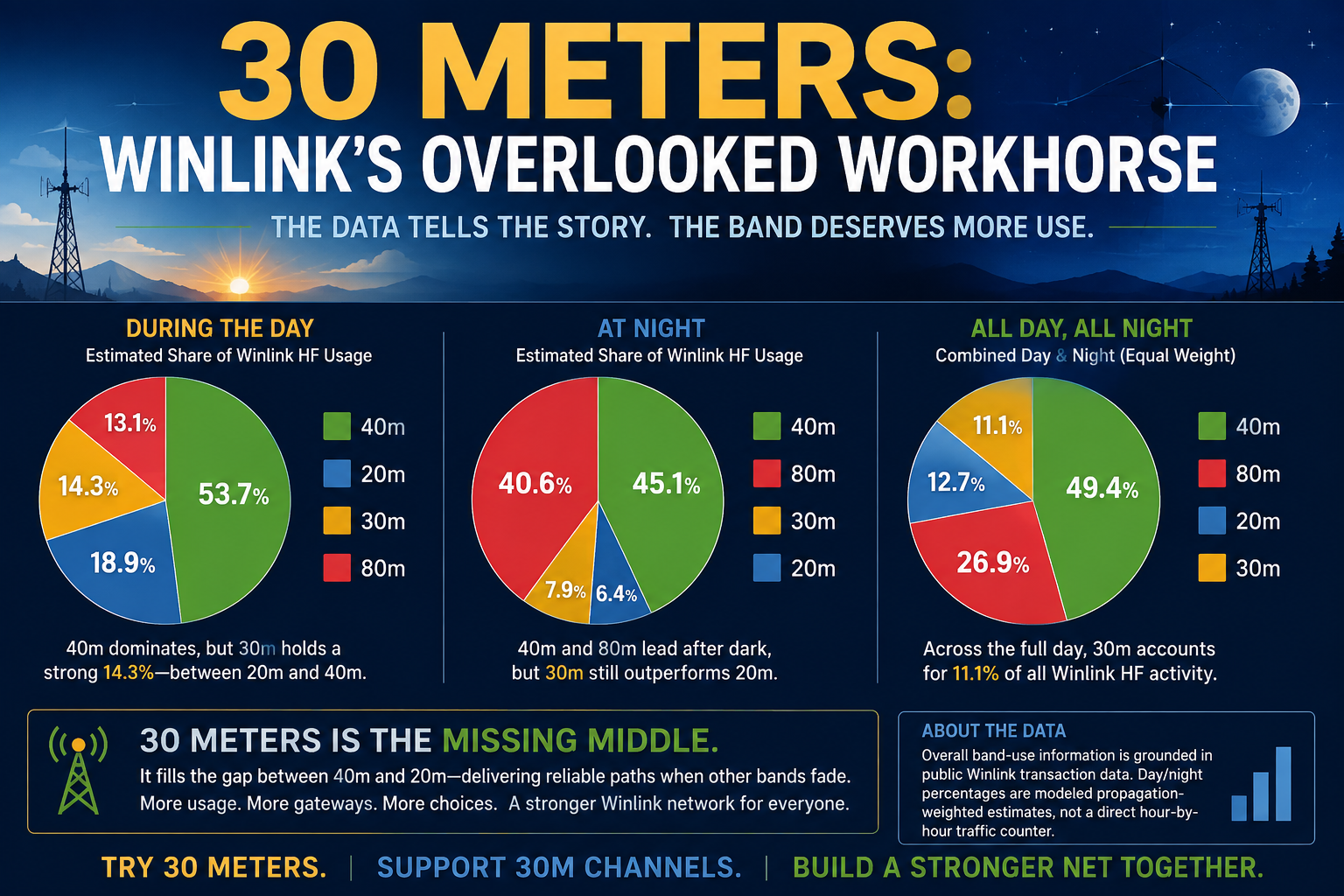
I’ve been digging into Winlink HF usage to get a better picture of which bands are actually carrying the system and how that changes between daylight and darkness.
The results weren’t terribly surprising at the top of the list: 40 meters is the workhorse of Winlink HF. But the numbers also make a pretty good argument that 30 meters deserves a lot more attention than it gets.
Using public Winlink transaction information as a baseline and then modeling the four primary HF data bands for daytime and nighttime propagation, we came up with the following picture.

During the day
- 40m — 53.7%
- 20m — 18.9%
- 30m — 14.3%
- 80m — 13.1%
Forty meters remains dominant even during daylight, while 20 meters becomes considerably more useful for longer paths.
But look at 30 meters: 14.3%.
It is already holding its own between 20 and 40 meters despite having nowhere near the visibility or popularity of either band.
At night
The picture shifts considerably:
- 40m — 45.1%
- 80m — 40.6%
- 30m — 7.9%
- 20m — 6.4%
Once darkness sets in, 40 and 80 meters become the big players.
But notice something interesting again: 30 meters still slightly beats 20 meters in our nighttime model.
Put the entire day together

If daytime and nighttime are weighted equally, the modeled overall Winlink HF picture becomes approximately:
40m — 49.4%
80m — 26.9%
20m — 12.7%
30m — 11.1%
In other words, almost half of the activity gravitates toward 40 meters.
That makes sense. Forty meters is incredibly versatile.
But I think the more interesting story is 30 meters.
Why aren’t we using 30m more?
Thirty meters sits in an exceptionally useful place between 40 and 20 meters.
When 20 meters is getting too long, or beginning to fade, and 40 meters isn’t quite giving you the path you want, 30 meters can be an excellent middle ground.
For Winlink in particular, it has several things going for it.
First, 30 meters is already essentially a data-oriented band in the United States. There is no traditional amateur phone operation competing for space.
Second, it is a WARC band, so you don’t suddenly find yourself trying to move emergency or routine digital traffic through the middle of a major weekend contest.
Third, its propagation can make it an excellent transition band.
During the day it can provide longer reach than 40 meters without requiring the conditions that sometimes make 20 meters possible.
Into the evening, it can remain useful after the higher bands begin deteriorating.
That doesn’t mean 30 meters replaces 40, 80, or 20.
That’s exactly the point.
It fills the gap between them.
For a system like Winlink, where the goal isn’t making the most exciting contact but rather reliably moving a message from Point A to Point B, having another dependable propagation option is valuable.
And redundancy is valuable.
If almost everybody builds their HF infrastructure around the same couple of bands, we aren’t taking full advantage of what HF gives us.
More 30-meter RMS channels would give users another choice when propagation on 40 or 20 isn’t cooperating. More users trying 30 meters would give RMS operators more reason to support it.
It’s a bit of a chicken-and-egg problem.
People don’t use 30m because fewer gateways are available on 30m.
Gateway operators don’t add 30m because fewer people are using 30m.
Somebody has to break that cycle.
I think Winlink operators should.
If your equipment, antenna system, licensing, frequency coordination, and operating situation allow it, give 30-meter Winlink a try.
And if you’re running an HF RMS with the ability to support another band, 30 meters deserves serious consideration.
Forty meters may be the king of Winlink HF.
But 30 meters might be the most underutilized tool in the toolbox.
One important note about the graphs: the overall band-use information is grounded in public Winlink transaction data, while the daytime/nighttime percentages are modeled propagation-weighted estimates rather than a direct hour-by-hour Winlink traffic counter. They should be viewed as a planning and comparison tool rather than exact traffic statistics.
Leave a Reply